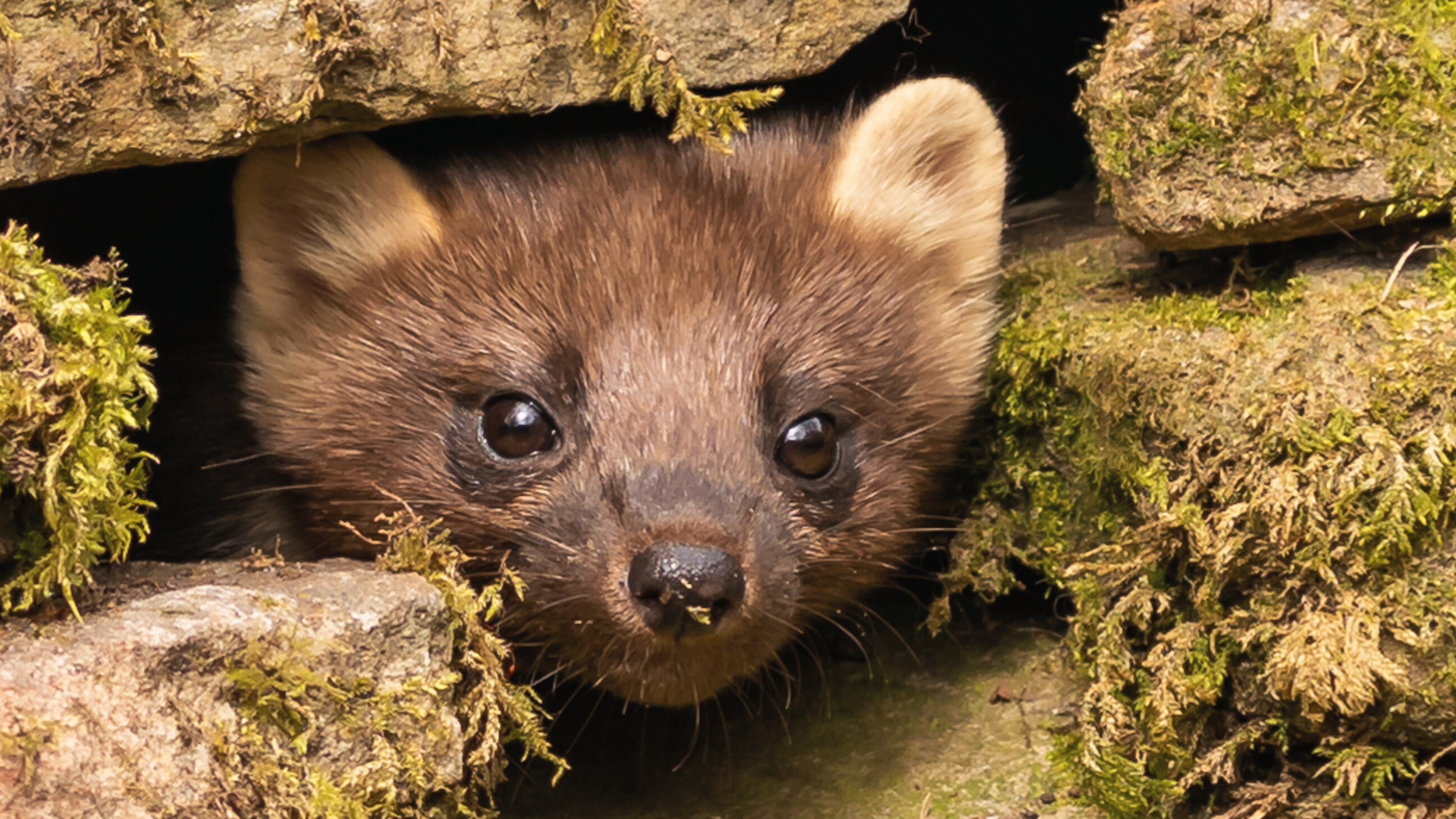
The Elusive European Pine Marten
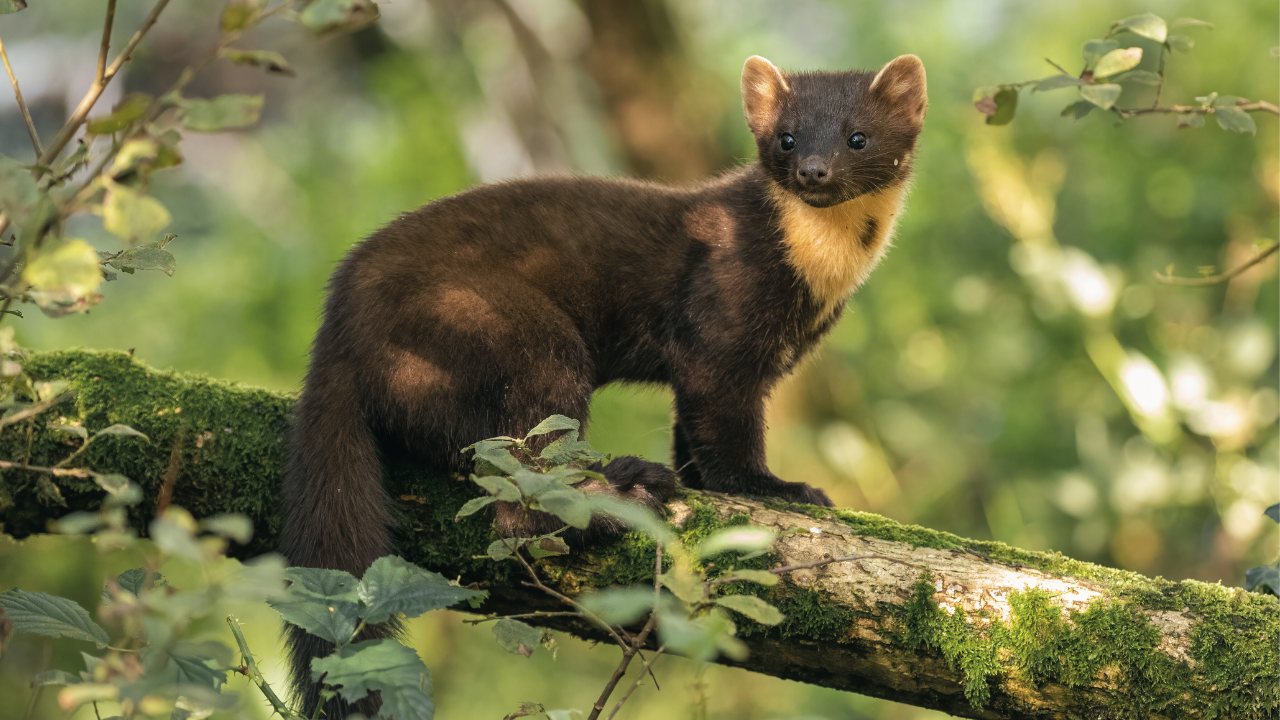
The pine marten’s Latin name, Martes martes, comes from a word used by the Romans for woodland predators.
My Encounters
So far in my life, I have seen two pine martens, or possibly the same one twice, in two consecutive years (2024 and 2025) at the Argyll Beaver Centre hide on the edge of a woodland in Scotland. The very first time, I was sat on the floor of the hide using one of the ground level hatches to film the area. The pine marten walked around the hide and right past the hatch where I was sitting. I froze, not wanting to make a sound that might alert him or her (I’ll use her for ease of writing) to my presence. Beyond the awe that my dream of seeing a pine marten in real life was coming true just a couple of feet from me, I noticed her rich brown fur, the striking yellow bib, and her agility. She reminded me of a cross between a monkey and a cat as she deftly leapt from a log, bounded across the area, and scrambled straight up a tree. Her long tail helped her balance as she hung upside down from a branch moments later, attempting to pull a ball of suet from a bird feeder.
The next year, I watched from the same hide as a pine marten opened a bird feeder box and helped him or herself to the treats inside, chomping the food while looking around the area, before diving back in head first to retrieve another mouthful.
I also managed to capture some trail camera footage of a pine marten near Loch Etive.
Built for the Treetops
European pine martens belong to the Mustelidae family, a group of carnivorous mammals (though they are opportunistic omnivores), that includes weasels, stoats, polecats, ferrets, badgers, otters, and martens. What makes pine martens stand out is their arboreal lifestyle: they regularly move, hunt, and rest high in the trees, using their sharp, semi‑retractable claws and long tail for balance.
They are long, lean, and agile, measuring around 45–55 centimetres from head to body, with a tail adding another 20–25 centimetres. Adults usually weigh 1–2 kilograms, with males tending to be slightly larger than females. Their rich, chocolate-brown fur, often darker along the back, provides camouflage in the woodland. The pale yellow or cream bib on the throat and chest is one of their most recognisable features; its precise function isn’t fully known, though it may help pine martens recognise one another or simply be a distinctive genetic trait.
The face is narrow, with dark, alert eyes, a pointed muzzle, and rounded ears, giving a keen and expressive appearance. Their teeth are sharp and strong, perfectly suited to an opportunistic diet of small mammals, birds, eggs, insects, and fruit. Whiskers help them sense their surroundings as they move through dense vegetation or in low light, compensating for the fact that their eyes, while excellent in dim conditions, cannot see in complete darkness. Seasonal changes in fur thickness help them stay warm in winter and comfortable in summer.
Pine Martens in the UK
Having grown up in Gloucestershire, and now living in Cornwall, I have never had the privilege of seeing pine martens regularly. Scotland is indeed a stronghold for these mustelids, with the largest and most stable populations found across much of the Scottish Highlands and other northern and central areas, where they remain locally common after legal protection allowed numbers to recover following severe historic declines.
Elsewhere in the UK, pine martens were once widespread but became very rare in England and Wales by the early 20th century due to habitat loss and persecution. They have been making a gradual comeback through a combination of natural expansion and carefully planned reintroductions. In mid-Wales, a project between 2015 and 2017 translocated 51 martens from Scotland, resulting in a viable population that is now spreading.
In England, small populations have been established in the Forest of Dean following releases between 2019 and 2021, and in Devon where 15 animals were released on Dartmoor in autumn 2024 with successful breeding recorded in 2025. In autumn 2025, a further release of 19 pine martens took place on Exmoor as part of the Two Moors Pine Marten Project, marking their return to that region for the first time in over a century.
Overall, pine martens remain rare in England and Wales and are listed as critically endangered in those nations by the Red List for Britain’s mammals, while in Scotland they are considered least concern due to stronger and more established populations.
The Lone Marten
Pine martens spend most of their lives alone. Adults move through their own home ranges rather than forming social groups, and although territories can overlap, individuals generally avoid one another outside the breeding season. They communicate largely through scent marking, which helps maintain spacing between animals without frequent direct encounters.
They are rarely seen because they are mainly active from dusk through the night, move quietly, and spend much of their time in dense woodland cover and high in the forest canopy. They also rest in concealed places such as tree cavities, old squirrel dreys, rock crevices, and thick vegetation. This behaviour and choice of habitat allow them to remain present in an area while going largely unnoticed.
They come together only briefly to mate, usually in summer. After mating, the pair separates, and there is no lasting bond. Pine martens show delayed implantation, so although breeding occurs in summer, the young are not born until the following spring, typically March or April. Litters usually contain one to five kits, born blind and helpless in a well sheltered den. The female raises the young alone, with no involvement from the male, until the young begin exploring and later disperse.